Feathering
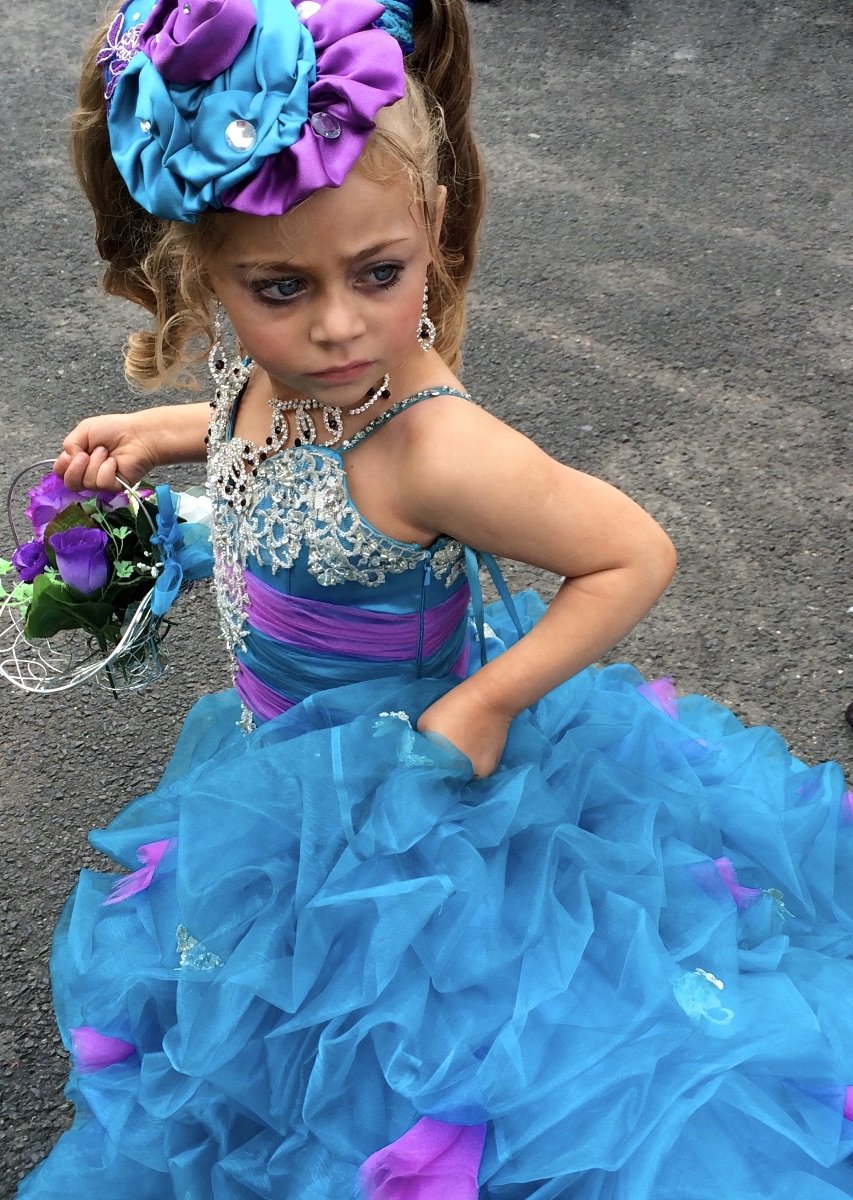
On learning to hold yourself the way you always hoped someone would.
I am walking through Kilkenny, feeling how uneven the cobblestone rises up beneath my shoes. It’s not what I expected. Nothing ever is. And then the church doors open and the wedding party bursts onto the street all at once. The energy is electric. The colours are everywhere — fuchsia, turquoise, tangerine, lavender. Kisses, hugs, laughter, photographers, toddlers, teenagers — and before I know it, my body is doing the thing it always does in the presence of joy: reaching out, wanting to hug someone, anyone.
And then I see her.
A young bridesmaid. Stomping.
Her expression stops me. It has been a very long day. Her stormy blue eyes say it all — she has had enough, and she is not hiding it. Little feet on cobblestone. Shiny eyes glaring with outrage at no longer being the centre of attention. Temper mixed with a little pout. Unedited. Visible. Raw.
How pure. How glorious.
I took her picture.
I saved her amongst my favourites. Every once in a while, she would catch my eye again — just like she did that day on the street. A little reminder, sitting quietly in my camera roll, waiting.
I didn’t know what she was waiting for. Not yet.
— — —
It is just a regular Thursday when I understand.
The day has felt like the electricity in the air before a thunderstorm. Hot. Prickly. Begging for the moment where the clouds pummel one another, and it starts to pour. The feelings come like a cold plunge — fast, brutal, heart racing — and if they don’t drown me, they leave me grateful to be alive and bracing for the next one. Flashes of a love I am still carrying. The exhausting frustration of reaching for someone who will not be reached. The evasion. The closed door. The way you have to come back from that moment of reaching and pretend, on the way back, that you hadn’t been standing there with your hand out.
I have been managing it all day. Keeping the lid on. Presenting fine.
And then I am in a supermarket car park and a shopping cart comes barrelling across the lane and takes out my front light.
I am about to grind this, too, into another headache. And then I catch it — a flash of turquoise. The post marking my spot. D4. Bright and ordinary and somehow, suddenly, the colour of a little girl in a taffeta dress on a cobblestone street in Kilkenny. And I remember: loud has a place. Feelings have a place. I have a choice.
I slam my fist down on the steering wheel. I could bite it. Something rises from below my solar plexus — from somewhere deep and ungovernable — and the sound that comes out is not coming from my mouth. It is coming from my skin. I am sure of it. I am sure I have cracked the windshield. That every sensor in this car has gone off.
And then — nothing.
The sound stops. What comes after is not silence exactly. It is the absence of the sound. The space where it was. The thunderclap was not collapse — it was a chemical reaction, friction catching in the air, a force I created and then detonated. And in its wake, something I did not expect: peace. The eye of the storm. Not a consolation. Something I can trust. Like the ache after a long run that asks for tenderness but also proudly proclaims — we just did that.
I hit the start button. I reverse out slowly. I drive home with one intention: preserve this. Stay inside the eye of the storm.
I leave the groceries on the counter. I don’t put anything in the fridge. I run — not walk — directly upstairs. I turn on the bath. I crack the window. I strip down.
I sink in.
— — —
I watch my hands slowly prune in the water. The skin gathers and folds. And I think — these are my grandmother’s hands.
She was an immigrant woman dealt a hand of hard work and survival. Our time together was spent cleaning the rooms of the motel she owned. It never occurred to me to ask for help reaching the top of the mirror. I learned to pull a chair over, gingerly angle the Windex, flick my rag at the upper corners without leaning on the glass. Problem solved. No one needed.
I learned the world through her hands. They moved fast. Efficient. The muscle visible beneath the skin, the veins throbbing as she grabbed the rag and pushed and pulled. We were in gratitude, always, that we had the opportunity to make a life. And we were in a deep, unspoken terror, always, because she was never far from the things that had chased her from her home country.
Tenderness did not come in playing games. It came in instruction. How to wash a mirror. How to clean a toilet. How to pull a chair over and manage, quietly, on your own.
She taught me that survival depended on leading the charge. On capability. On never flinching, never needing to be carried. There was no time for gentleness. No time to be rescued.
But at night — only at night — only when the lights were all off — only when she thought I was already half asleep — those same quick hands would find me. She would gently straighten my pink pyjama top, smoothing away her worries and my rumples from too much tossing. A tenderness that could only arrive in the dark. Only when no one was watching.
Only if I didn’t ask too much.
I inherited everything she gave me. Including the rule about not asking.
— — —
In the bath, my tears arrive before I have decided to cry. The cry turns into a sob. The warm water is the closest thing I can feel to safety right now. The heartache I have been carrying — and am choosing to carry, am not ready to put down — feels heavy in a way I don’t want to wish away. But I am tired of tasting it like bile.
I don’t know when I drift. The water cools, and I don’t notice. It isn’t numbness — it’s something else. I become the water for a little while. No edges. No sharp angles. Just something fluid and without a fixed shape, breathing slowly, the heartache still present but no longer pressing.
My heart doesn’t feel okay. My head has no energy for next steps. But in this liquid, edgeless state, something in me gets quiet and starts to talk. Not in full sentences. Short ones. The kind you use with a little one.
Let’s dry you off.
Time for bed.
Let’s get cozy.
Here’s your favourite pillow.
Tomorrow. I’ll deal with all of it tomorrow. Tonight, the only thing I need to do is get out of this tub.
— — —
That fierce little bridesmaid didn’t stay fierce for long. Moments later, a sharply dressed man — her father, I think, or a loving uncle — bent down and scooped her up. He lifted her high, up to chest height, so that she could see into the faces around her. He didn’t shush her. He didn’t manage her back into presentability or move her away from her moment. He said one word.
Yes.
A simple acknowledgement. That the feelings were big. That loud, like her turquoise dress, had a place.
He held the space while she moved through it. Still mid-feeling, still flushed, her small hand gripping his lapel — held, not fixed.
I have been waiting for that. For someone to lift me up and say yes. To hold the container while I fill it.
No one comes.
It hits like a sudden drop. Terrified, I feel myself lurch, gripping my own arms, hoping the umbilical cord is still attached to something — anything. And then, slowly, the way you find your footing after the ground surprises you, I breathe.
I am in the bathroom with pruning hands and a cooling bath and the specific, unglamorous, necessary knowledge of what I have to do next.
I dry myself off. Short strokes. Careful. Like I am handling something precious.
Let’s get you warm. Let’s get you cozy. Here’s your favourite robe.
I pull it on. Soft fabric tied around my waist like a small ceremony, a decision made entirely on my own behalf. I open Spotify to French Tania. I open a new book. I read until my head bobs with drowsiness, until the words blur at the edges.
And somewhere in the drowsiness, I say it. Out loud, or close enough.
I got you.
— — —
This is what I mean by feathering.
Not the nest itself. The structure. The container. The life that holds you.
But the act of lining it. The pulling of softness from your own chest and pressing it into the corners. The daily, quiet refusal to leave yourself without somewhere to land.
My grandmother could only be tender in the dark. When she thought I was already gone. When no one was watching.
I am learning to be tender with myself in broad daylight. To say yes to the big feelings. To lift myself up so I can see into the faces around me. To hold the space while I move through it.
To say I got you before the lights go out.
Not control — love.
Not managing — tending.
Not waiting — feathering
Feathering
— — —
Tania Carriere believes the most radical thing a person can do is stay soft in a world that will harden them if they let it. She is a writer, life coach, retreat leader, and TEDx speaker living between Canada, France, and Baja. advivumjourneys.ca