On wandering, belonging, and the cost of staying open
The Manitoba March wind doesn’t just cut — it enters. Through the gap between your hat and your collar, down your ear canal, into the soft tissue of your nostrils. Cold enough to singe. Cold enough to make you understand, on a cellular level, why the settlers who came here were either extraordinarily brave or extraordinarily lost.
I was neither. I was a city girl from Ottawa in track pants and a borrowed farm jacket that came down to my thighs and smelled powerfully of everything a farm jacket should smell of. Underneath: two pairs of woolly socks inside rubber boots, a turtleneck, a sweatshirt, a woolly hat yanked so far down it covered my eyebrows and both ears entirely. In my hand: a shepherd’s crook, because apparently startled labouring mammals can charge, which was information I did not have before I agreed to this.
I had agreed to this.
Everyone I told shook their head.
But you barely know them.
What will you talk about?
What if they’re weird?
What if I’m weird, I did not say. What if weird is the whole point.
Sharon and Rick were friends of my husband’s — people I’d met briefly when they passed through Ottawa, the conversation doing the usual polite circles until somehow, inexplicably, I heard myself say: if you ever need help delivering calves, just give me a shout. I do not know what possessed me to say it. I do not know what possessed them to say okay. But a few months later I found myself at the end of the longest laneway I had ever seen, the kind of laneway that takes so long to drive up that by the time the farmhouse appears you understand there is no backing out. The muck alone would swallow your retreat. The sky was that particular Canadian blue that exists only in early spring — vast and cold and shockingly beautiful — and the wind was trying to remove my face.
I was absolutely delighted.
Last week, seven years later, I nearly snorted a soft drink out of my nose laughing about it with Sharon and Rick. We were remembering. The avocado I placed on their breakfast table while they regarded it with the careful neutrality of people encountering an alien object. The singing. The expression on their faces during the singing. Rick will never eat an avocado. I will never watch a roundup. And yet here we are, seven years later, laughing so hard it’s a hazard.
We are laughing, mostly, because of the Ave Maria.
Sharon and Rick ran a serious cattle operation.
A hundred calves that season.
They knew exactly what they were doing and so, it emerged, did the cows. That first night on the 2am shift, Sharon pointed out a cow she’d been watching — a first-time mother, moving in slow restless circles, and around her, something I was not prepared for: the other cows had formed a loose circle of their own. They were there. They were present. Low soft moos moving between them like a conversation older than language.
She’s close, Sharon said quietly.
We stood behind a fence barrier — charging cow, always a risk — and watched. I had arrived with the idea that I was there to help. To midwife possibility into the world. Instead I stood in the dark in my ridiculous outfit holding a shepherd’s crook I wasn’t going to need, watching something ancient and sufficient and completely without need of me.
And yet.
I wanted to belong to that circle. Not as a farmer, not as a helper, not as a vegan city girl with a shepherd’s crook and no useful skills. Just as a creature. Just as another warm body in the cold dark saying I am here and this matters and I will not look away.
Reverence moved through me and came out as sound.
Ave Maria. Softly, into the dark. The labouring cow threw her head back and bellowed her own melody directly over my careful baseline. Sharon and Rick looked at me with the expression of people storing a memory they would be dining out on for years.
Which, seven years later, they confirmed they had been.
You started to SING.
I know. I would do it again. It’s the most natural thing in the world — to sing into the birth of a new moment. To offer the only true thing you have when everything useful has already been taken care of.
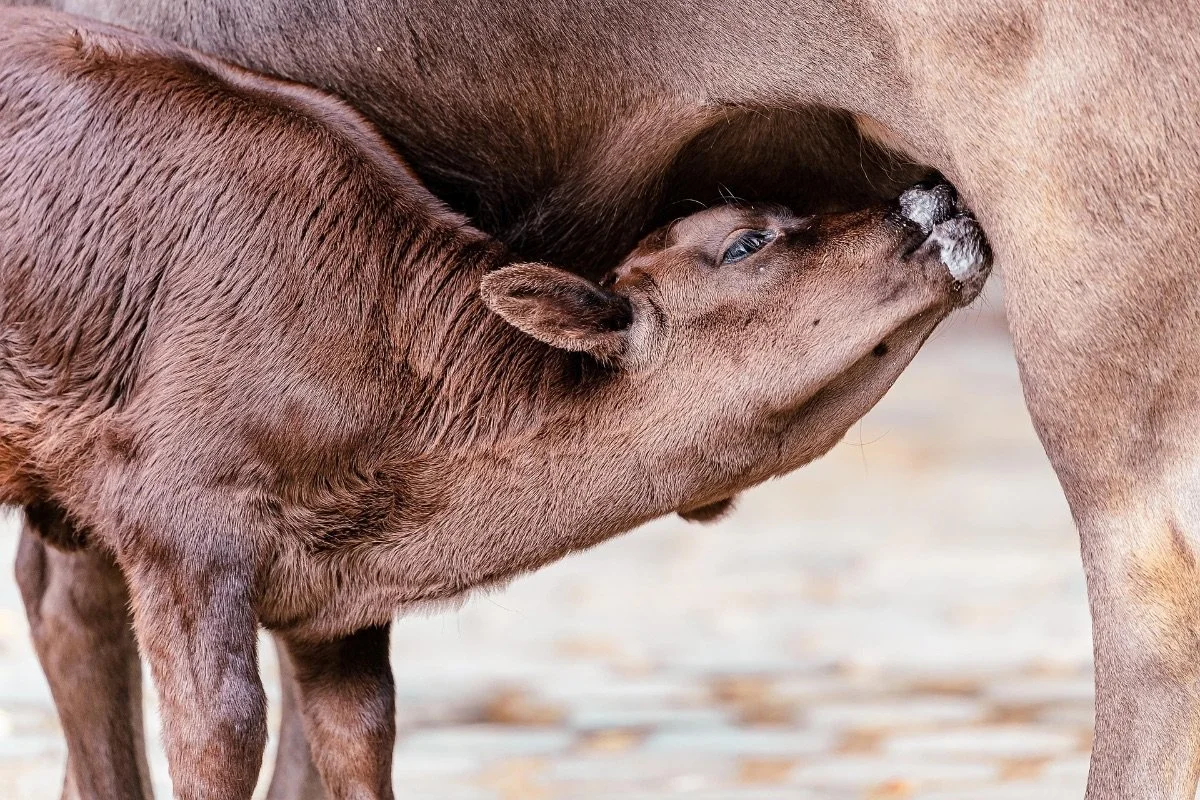
The calf arrived slick and magnificent. She began immediately the complicated project of figuring out her legs — long and knobbly, bum in the air before the rest of her understood the order of things. She swayed. She tilted. Found something like vertical. Stood there breathing her first breaths of Manitoba March air — pitch black and yet the stars the brightest I’d ever seen, beyond freezing and yet somehow held, among strangers and yet, in the intention of showing up, suddenly kin.
And then she looked up.
The softest eyes. Calm. Open. Just here.
I said nothing for a moment. The whole noisy sacred night went still.
Hi.
Barely a whisper. Just two creatures meeting each other in the oldest possible way, nothing to negotiate or explain. She looked at me and I looked back and something passed between us that I don’t have a better word for than recognition.
Then Sharon moved quietly beside me. We needed to get them both into the barn.
It was there, in the warm dim light, that I noticed the other calf.
In a pen just off the main area, a smaller drama was unfolding without an audience. Another new mother, another first calf — but this one the mother wanted nothing to do with. Every time the little one wandered over, hungry and hopeful, the mother moved away. Sometimes worse. A back leg swinging out. A refusal so complete it had a sound.
The calf didn’t understand. She kept trying anyway.
Sharon tied the mother in the pen. Brought her a bucket of oats — rich, fragrant, distracting. And in the moment the mother’s whole attention went to the sweetness in front of her, the little calf slipped in sideways and took what she needed.
I stood at the gate in my woolly hat and my borrowed jacket and felt something move through me that I didn’t have words for yet.
There you go, little one. Take what you can. This is your chance.
Two days later I woke to bellowing.
I thought something must be wrong with a birth. I splashed water on my face, dressed, came into the kitchen — and walked into a particular kind of quiet. Sharon and Rick were there and something in the air was careful. The bellowing outside was continuous. Mothers looking for their yearlings. Yearlings in a trailer, unsure and calling back.
They told me what the day’s project was.
I grew still. My brain said you have to be okay with this, it’s part of life. My heart lurched and twisted and would not be managed. I clenched my teeth against the bile creeping up my throat.
I left quietly. No pronouncement. No speech about the ethics of cattle farming or the sorrow of separation. Just a woman who had reached the edge of what she could hold, choosing to leave before she went numb.
They knew. I think they had known since the Ave Maria.
This is what wandering costs: you feel everything. You walk into barns and kitchens and strangers’ lives without the protective layer that familiarity builds. Every calf is the first calf. Every bellowing is the first bellowing. You never quite develop the useful callus.
This is what it gives: you never stop hearing it either.
But here is the thing I am still learning to say out loud:
I am the calf in this story too.
I am the one who drives down ridiculous laneways into the unknown, dressed in the wrong clothes, carrying tools I don’t know how to use, singing into the dark because reverence has to go somewhere. I am the one who slips in sideways, hoping the world will be distracted enough by something sweet to let me take what I need.
I am the one looking up, soft-eyed, hoping someone will say hi back.
The world is not clean or simple or managed. It is beautiful and vicious and it holds every colour at once — the sacred and the brutal, the hilarious and the devastating, the moment of connection and the moment of loss, sometimes separated by less than forty-eight hours. The best I can do is practice holding all of it. Not looking away. Not going numb. Not staying in the room past what I can hold.
Showing up in the wrong outfit.
Singing when reverence demands it.
Leaving quietly when I’ve reached my edges.
And always, always watching for the moment when something looks up with the softest eyes and the world goes still and there is nothing between us and everything is possible and the only word that rises — the simplest, most ancient one there is —
is Hi.
I say it back every time.
Tania Carriere believes the most radical thing a person can do is stay soft in a world that will harden them if they let it. She is a writer, life coach, retreat leader, and TEDx speaker living between Canada, France, and Baja. advivumjourneys.ca