FLIRTING WITH LIFE: A French Lesson in Love
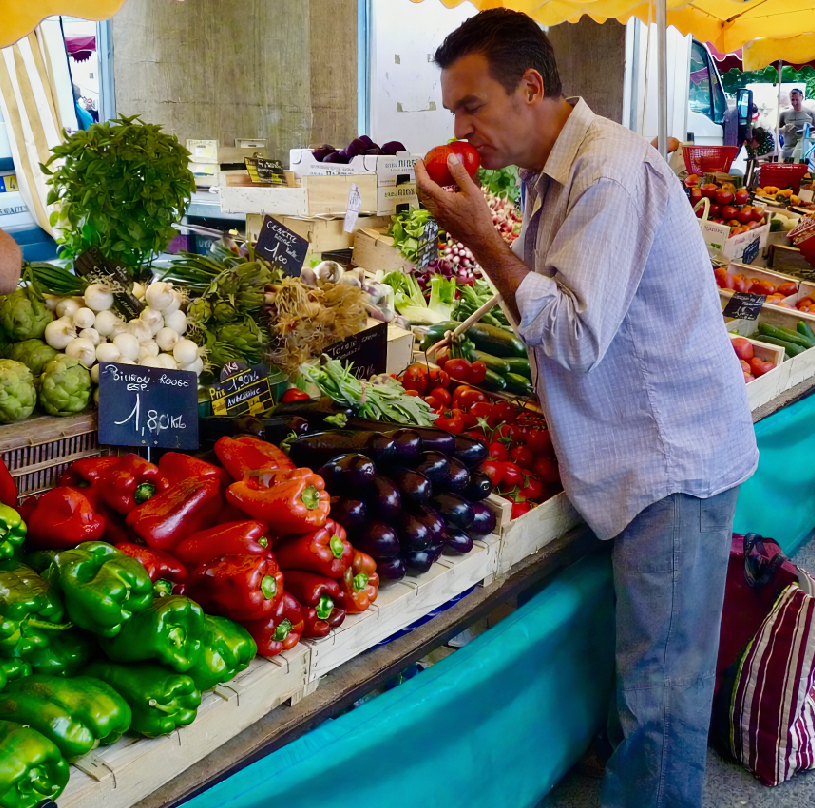
I know I'm staring, but I can't look away. This Frenchman is falling in love with a tomato, and it's the most romantic thing I've seen in years.
I came to Provence the week after my birthday—another one—with the unsettling realization that I'd forgotten how to taste my own life. My marriage had ended amicably (we uncoupled, stayed friends, all very evolved), but it still stung in ways I wasn't ready to name. Mostly, it opened up a question I didn't have an answer for: What now?
I'd become jaded about romance. About love. About the whole tender, ridiculous business of letting yourself feel things. I was running on autopilot, going through motions, checking boxes.
And then I saw him with that tomato.
He's wearing weathered linen—the kind that's been washed a hundred times and still looks expensive—and his fingers trace the air before they even reach the tomato, as though he's already making love to it in his mind. The crinkles around his eyes could be from sun or laughter or probably both, because in Provence, those things are the same.
The market is a crush of bodies, and I'm letting it carry me. Warm croissants and peonies—that's what Lourmarin smells like on a Friday morning. Women walk arm in arm with straw baskets the size of small children, their espadrilles shuffling on cobblestones, their lipstick the only thing bolder than their opinions. Sun drips through the platanes in fat golden coins. Even the bees are drunk and lazy, tumbling through blossoms like they've got all summer and nothing to prove.
I can't take my eyes off this man.
He picks up an heirloom tomato—one of those ugly-beautiful ones that costs more than it should—and holds it like it might break his heart. He closes his eyes. Leans in. Inhales so deeply that his shoulders rise and fall. Then he does it: that little shoulder quiver, that frisson, and he sighs like he's just been kissed by someone he's been longing to kiss.
The woman at the stall practically glows.
The tomato seduced him into coming home. Or maybe he let it. Either way, this is how the French shop—they allow themselves to be courted by vegetables.
Here's what I'm learning: joie de vivre isn't something that happens to you. It's not a mood that descends if you're lucky or if the light is right. The French don't wait for joy to arrive as the result of living—they take it FROM living. Actively. Intentionally. With both hands.
I've been circling this market for twenty minutes, watching everyone else lean in while I keep my hands to myself. Earlier, I caught myself running my fingers along a basket of apricots—feeling their velvet skin, the give of ripeness—and I actually pulled my hand back as if touching fruit required permission. As if feeling something might expose me.
That's when I realize: I came to Provence to find joie de vivre, but I've been treating it like something that happens TO you if you're lucky enough. Something you observe from a respectful distance.
The French don't do that. They reach. They touch. They let themselves be courted by vegetables.
So I make a choice. I approach the cheesemonger.
He's standing behind wheels of Beaufort, Comté, Morbier, and those small, perfect discs of chèvre that look like they were made by someone's grandmother who doesn't believe in measurements. When he sees me coming, he smiles—not the professional smile you give tourists, but the anticipatory one you give a co-conspirator.
"Just wait," he says, leaning forward, "until you taste these."
No rush. No clock. Just cheese and time and the distinct possibility that I'm about to fall in
love in public.
He introduces each cheese like a potential lover. I smell them. Feel their texture—some firm, some giving, one so soft it nearly collapses under my thumb. I taste them slowly, letting them melt on my tongue, and somewhere between the Comté and the Morbier, I feel that shiver start.
When I suggest I might be taking too much of his time, he laughs—a low, warm sound that suggests I've missed the entire point of being alive.
And honestly, at this moment, I can't remember what the point was before this.
I'm blushing now. Actually blushing. Heat creeping up my neck because I've realized something: I'm not just adoring the cheese. I'm adoring him—his patience, his hands, the way he's watching me taste. And then, in a twist I didn't see coming, I'm adoring myself. This spunky woman willing to swoon over dairy in a French market while strangers watch.
I feel drunk. Giggly. Could not blush harder if I tried.
He accepts me immediately. Because I've done the thing—I've leaned in. I've chosen to extract joy from this moment instead of waiting for it to be delivered to me.
Eventually, I choose something to take home. He wraps it like a gift, tells me the exact temperature to serve it (room, let it breathe), the wine to pour (something local, not too serious), the meal to follow (something simple—the cheese is the star).
I've had dates with less foreplay.
That evening, I unwrap my cheese. Leave it on the counter, as instructed.
"Bonjour, mon ami," I say to it, completely sober and completely serious. "I've been thinking about you all day."
The flirtation continues. The cheese, the wine, the evening light coming through the window.
This morning, back home, I went to my farmer's market. Picked up a peach. Didn't pull my hand away this time. I closed my eyes. Inhaled. Let my shoulders quiver.
The farmer grinned at me like we were in on the same magnificent secret.
We were.
I'm not waiting for joy anymore. I'm courting it. Taking it FROM the living instead of hoping it arrives as a result of living. And it turns out joy has been waiting all along—it just needed me to stop being so careful, so jaded, so afraid of feeling something in public.
I was invisible until I was willing to swoon.
One gorgeous, blushing epiphany at a time.
