Leaking
On the Radical Act of Feeling the World
Sometimes I don’t know who is crying.
I become aware of it the way you notice rain — it simply is, and you can’t say when it started. My face is wet. Something in my chest has opened. I have learned to call it leaking, and I have learned — slowly, imperfectly, with considerable resistance — to meet it with the only question that actually helps: What do you need, babe? I’ve got you.
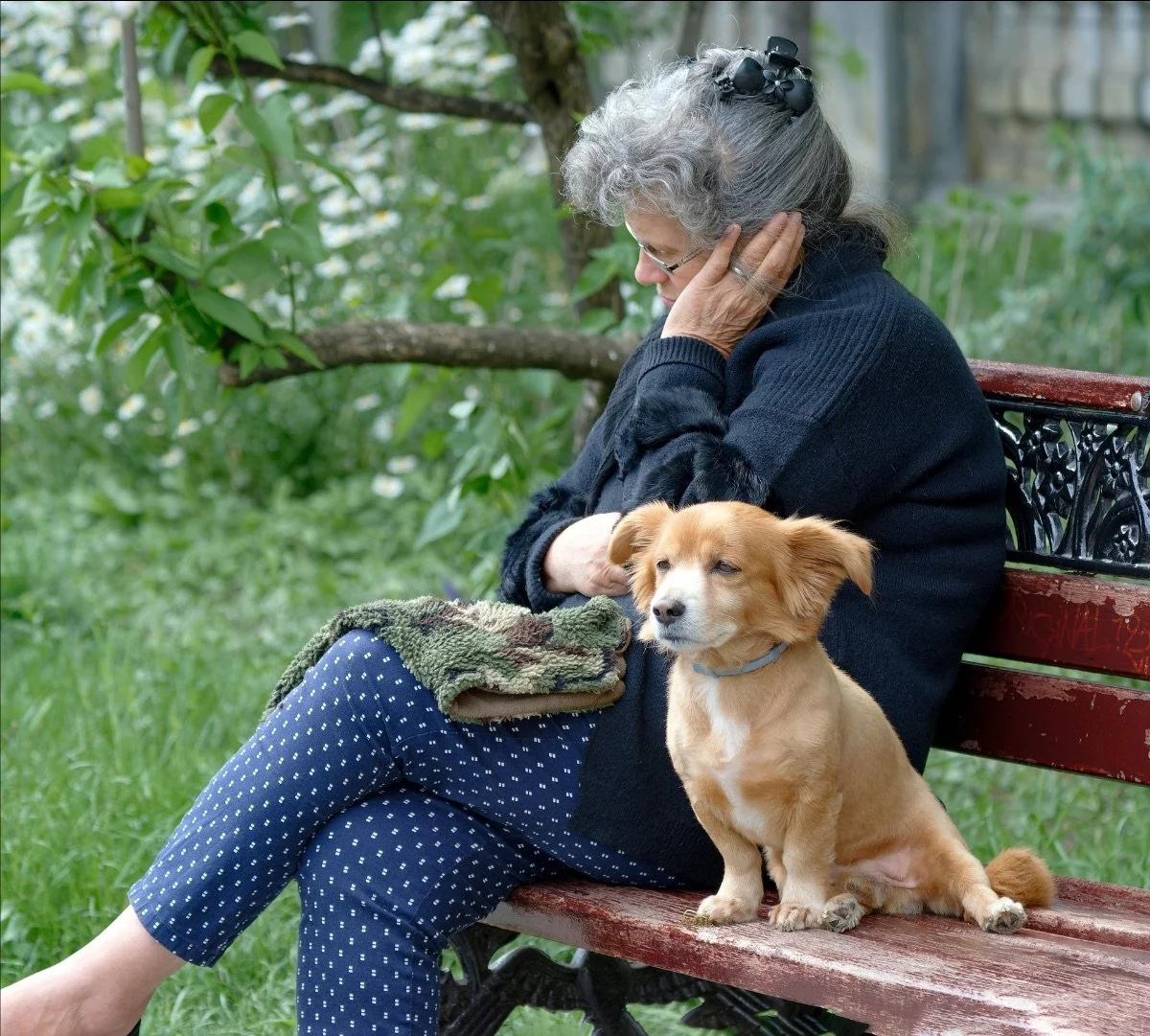
The answer, last Tuesday in a garden, was apparently: a stranger’s dog with the same ears as the one I lost.
He came around the corner at speed, tail operating independently of the rest of him, and I knew before I fully understood why — the colouring, the ears, something in the angle of the head — that this small creature was a twin of one who had recently left my heart.
What followed was not dignified. Tears and laughter arrived simultaneously, which is to say: spittle, and a snort I will not describe further, and my hand over my mouth, and absolutely none of it containable.
I stood my ground anyway. I did not flee to a bench or suddenly become very interested in my phone. I crouched down, fully ridiculous, and the dog pressed himself against my leg as if we had a prior arrangement.
His owner approached. She didn’t ask if I was alright. She put her hand on my back — just between the shoulder blades, the way you do when words would be too small for the moment — and kept it there. When I looked up, her eyes had gone soft and a little bright.
She knew. She offered what she had. It was enough.
I feel the world. I always have. I cry at the cardinals at the feeder — the male offering seed to the female as if it were a small ceremony, beauty that asks nothing of you. I cry at Amazing Grace in any form: the choral, the bagpipe, the terrible Muzak version in an elevator on the way to a quarterly review. It makes no difference.
For years, this embarrassed me deeply.
At the first sign of that liquid response, I’d lurch to cover it — a sudden joke, a hard pinch to my own arm, a camera raised like a shield. I’d been labelled sensitive, labelled emotional, and for a long time those words didn’t feel like things to be proud of. They felt like diagnoses. So I managed it. I hid the watercolour of the feeling that washed through my days and instead presented a person who had herself entirely together.
But their comfort cost me mine. A frozen shoulder. Tendonitis. Calf cramps that woke me at three in the morning, my body staging its own insurrection. A whole series of inexplicable contractions while my nervous system fought for the release I wouldn’t give it.
What I didn’t understand then was that my tears were the most honest thing about me.
I know them differently now. When the prickle comes — that familiar warning at the corner of my eye — I’ve learned to receive it as intelligence rather than blemish. My tears are my inner life putting a moment in BOLD, the way you’d highlight a sentence you need to return to. They surface only about what genuinely matters. And the leaking — the tears that arrive before I do, that are simply there when I find them — those are the deepest signposts of all. They have already done the knowing. All I have to do is follow.
What do you need, babe? I've got you.
I let them come until they don’t.
This past year, I wept in ways I hadn’t known were available to me.
My team and I were gathered, buzzing with that particular aliveness that comes just before retreat guests arrive — everyone in motion, in love with the work, in love with each other in that crackling pre-show way. And then it hit me the way you hit a patio door so clean you didn’t see it — a full-body collision with the realisation of what day it was. A day that was meant to be shared. A celebration happening somewhere without me. I doubled over. I could have choked it down. I could have run from the room. Instead, it squeezed out of me as a low moan that crept upward like a hot blush, and I let it come.
They stopped. Without a word, without missing a beat — hands around me from behind, a glass of water appearing, someone turning the music up to muffle the sound of me from the arriving guests. We just let the wave move through.
And then there was the flower shop. The smell hit me first — that heady, syrupy riot of colour and fragrance — and as I saw the peonies, an edge of memory scratched at the scab. Flowers once sent to me. Just as the young shopkeeper looked up and said, " Je peux vous aider?”, I felt them start — the heavy tears, the kind that cannot be held back, that leave a trail down your cheek.
How do you save that moment? You don’t. I smiled and said, “I’ll take five,” and left the story written on my face. She owns a flower shop to crack people open. Why deny her the truth of my humanity?
That was when I began to notice something unexpected.
When I stopped hiding — when I simply let the tears be present on my face and kept walking — people didn’t retreat. In the garden, on ordinary days, moving through the world with wet cheeks and no apology, I noticed strangers forming a quiet, instinctive barrier between me and the harshness of the world. The woman in the garden with her hand between my shoulder blades. The shopkeeper receiving the story written on my face. My team turning up the music without a word — my unhidden grief magnetising their tenderness, drawing out their own quiet knowing, and in the end drawing us all closer together.
I was jet-lagged, sleepless at four in the morning, finally surrendering to wakefulness and going out to walk. The city at that hour is a different city — pre-dawn quiet on the cobblestones, the light not yet decided. I found a bench in a small park and sat to watch the sky move from blue to grey to the particular pale gold that Paris seems to reserve for people who are up too early and a little broken.
I became aware gradually of a woman on a bench across from me. Impeccably dressed for that hour. On the phone. And in her posture — the particular held quality of a body containing something almost too large — I recognised something before I could name it.
She was saying goodbye to someone.
I knew it the way you know things before understanding arrives. I sat without moving, not wanting to disturb what I was witnessing. And then, unhidden and unasked, my own tears came.
Not for my specific grief, though there was still plenty of it, still tender at the edges. These were something else — a solidarity of the body, a recognition that the anguish of loving someone and losing them is not a private affliction. It is the oldest human experience there is.
I was not performing compassion. I was simply present, and my body responded the way bodies do when they are paying full attention.
She stood to leave. Our eyes met.
She saw my tears. I saw hers. Neither of us looked away. Neither of us moved to wipe them. We stood for a moment in what we had made between us — two strangers in a Paris dawn, refusing to pretend that life is not, in fact, this full.
I thought of the woman in the garden with her hand between my shoulder blades. I thought of the small dog pressing his weight against my leg, steady and warm, as if he understood the assignment.
Not rescue. Not resolution. Something quieter and more sustaining than either — the simple, radical experience of being witnessed. Of witnessing back. Of moving through the world with your face open and discovering that you are not as alone in it as you thought.
Sometimes I still don’t know who is crying.
My face is wet before I’ve asked any questions. Something in my chest has already opened, already yours.
What do you need, babe?
I’ve got you.
Tania