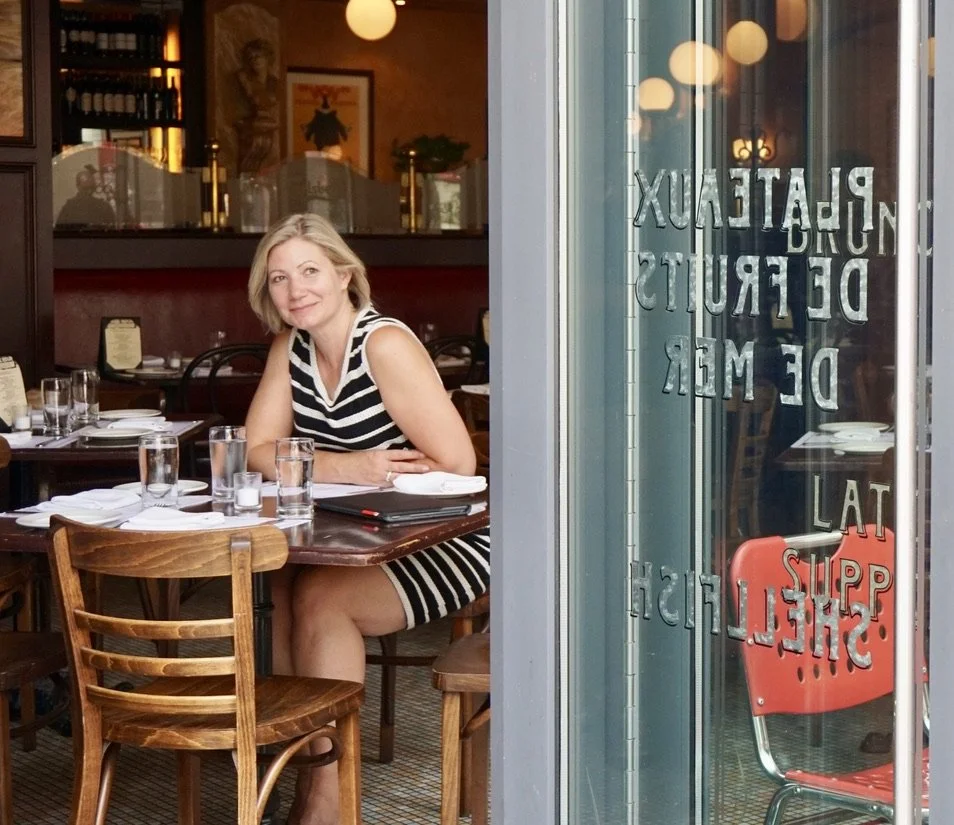
On boundaries, longing, and the life you forgot you loved
Precisely at noon, Provence stops.
Not winds down. Not slows. Stops. Shutters click shut mid-sentence. Stores pull their doors closed with quiet authority. Schools release their children into the streets, backpacks bouncing, and then — stillness. A whole town pivoting, simultaneously and without apology, toward what actually matters.
I stand on the empty laneway, my hastily grabbed market vegetables heavy in the straw basket, what should have been treasures now just weight. I will have to retrace my steps. Errands left undone.
I've come to Provence to study the art of living with Joie de Vivre. What I didn't expect was to spend the first week defending myself against it.
Back home I am productive. Capable. I run on a schedule so tightly packed there is no room for the unexpected, which is exactly the point. So when the bank closes at 11:30 for lunch and my meeting request is met with a firm ce n'est pas possible, madame, something in me doesn't just tighten — it panics.
I have a deadline. Self-imposed, yes, but the anxiety around it is entirely real. Everything seems to hang on meeting it — what exactly, I couldn't honestly tell you. But underneath the urgency is something older and more uncomfortable: the feeling that I have to justify being here. Prove my productivity. Earn my place at the table — the work table, the only one that counts.
The voices I am most afraid to hear are the quiet ones. Staying busy means I don't have to listen.
The two-hour lunch is non-negotiable here. Not a reward. Not a treat. Just — what humans do at noon. The first time I fully understood this, I felt something between outrage and grief.
On the fourth day I stop arguing and walk into a bistro that has just opened its doors.
My initial strategy is to be in and out in thirty minutes. Forty-five if the service is slow. What arrives instead is soup so extraordinary I will come back the next day just to have it again. Then a main. Then dessert. When the warm bread comes without asking I reach for it absentmindedly — until I feel a sensation from the inside out, of floating in another time. No butter needed. I reach for a second piece. No guilt, just desire. I start to pay attention.
The couple beside me smile and we talk a little about the old town, the magic of the stone streets. A woman across the room catches my eye and raises her glass. No one thinks I am awkward, eating alone. No one is watching the clock. There is no clinking of forks against plates — not because the room is quiet, but because no one is in any hurry to finish.
They are actually tasting their food. Stopping mid-conversation to savour something. Actually doing it, the thing we always say we'll do.
I eat for an hour and fifteen minutes and feel vaguely triumphant.
The waiter's expression suggests he finds this mildly tragic.
I stay in Provence long enough for the rhythm to begin to feel normal. Long enough that the noon stillness stops frustrating me and starts feeling like permission. Long enough to notice that my afternoons have a different quality — softer, less driven, as though something that had been clenched for a very long time is beginning, tentatively, to open.
I come home not knowing how to explain what has shifted. It isn't dramatic. I haven't had a revelation. I've just been living at a different pace for long enough that my old pace feels, for the first time, like a choice rather than an inevitability.
Then one afternoon I am walking down a street I never walk down.
I don't know what draws me there. But I see a café — sunlight streaming through the window, dark wooden chairs, warm green walls — and my heart does something it hasn't done in longer than I can remember. It aches. Not for coffee. Not for a reason. Just — in. I want to go in.
I have no work with me. No justification. Nothing to produce.
I go in anyway.
I take the window seat. Order a glass of wine. The afternoon light does what afternoon light does when you finally stop moving — it turns golden and a little sacred. A woman sits down one stool over. She is a good couple of decades older than me, something in her style unmistakably European. She orders a late lunch. I order a snack. We begin the way strangers sometimes do — carefully, then all at once.
I lived in Paris, she says, until my husband of twenty years died two years ago. I've come back to be close to the children. To start my life again.
I feel something loosen in my chest. Here I am, consumed with my own shifting and changing in midlife — and she is showing me there are even greater journeys waiting further into it. Something makes me reach toward her — "What would you tell someone like me — right now, in the middle of all of it?"
She sets down her glass. Looks at me. Then, a small flush of rose at her lips, she begins.
Before any dessert, dream, conversation, choice — I would have asked myself to believe that I am worthy.
Then a third woman walks in, takes the remaining stool, and something shifts in the room. For two hours we talk. Really talk. The kind of conversation that makes you feel both witnessed and expanded. I leave inspired, a little lighter, and — this is the part I didn't expect — more in love with myself.
More in love with the life I had built. The one that had been waiting for me to come home to it.
This is what I didn't understand about Joie de Vivre before Provence: it isn't a cultural quirk or a holiday indulgence. It isn't something the French have and the rest of us are charmingly denied. It is what happens when you draw a boundary around what you love and defend it — from your schedule, from your productivity guilt, from the voices that tell you joy must be earned.
The two-hour lunch isn't about lunch.
It's about knowing what you're hungry for. And deciding, at noon, with the whole town as witness, that you are worth feeding.
